A Time to Remember: Reflecting at the California Wildfire Memorial Groundbreaking
Over the last ten years, California has experienced some of the deadliest wildfires in its 176-year history. The 2017 Tubbs Fire. The 2018 Camp Fire. The 2020 North Complex Fire. The 2025 Palisades and Eaton Fires.
Across our state, communities have faced the devastating impacts of wildfires, each carrying stories of loss, healing, and hope. In Butte County, the 2018 Camp Fire remains deeply personal for many of us. The Camp Fire’s impact is still felt in the people, neighborhoods, and organizations like CHIP who are committed to helping our region rebuild and thrive.
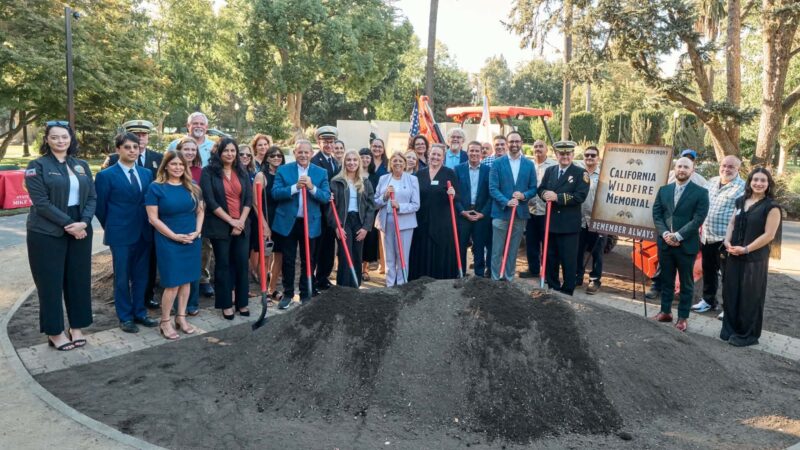
This year, CHIP Resident Services Manager Kate Scowsmith, a Camp Fire survivor, participated in a wildfire memorial groundbreaking event honoring those lost and affected by wildfires and reflecting on the journey that followed. Alongside State Senator Mike McGuire, Assembly Majority Leader Cecilia Aguiar-Curry, CAL FIRE Chief Joe Tyler, and Tubbs Fire survivor Paul Lowenthal, Kate joined others in reflecting on grief, resilience, and community.
We are pleased to share, with Kate’s permission, the words she delivered at the recent groundbreaking of the California Wildfire Memorial at Capitol Park in Sacramento, CA:
I come here not only as a Camp Fire survivor but also as a social worker, as previously the director of disaster case management for the Camp Fire Collaborative, also known as the Camp Fire Recovery Group. As a person who now works for an affordable housing nonprofit in Chico, CHIP, and, as of two years ago, a mom.
In November 2018, my family and I survived the Camp Fire. Like thousands of other survivors, we lost our home, our pets, our neighborhood, and life as we knew it. For me, the Camp Fire initiated a deep loss that still aches today, especially as I continue to write the chapters of my life after disaster.
When we talk about wildfire, so much of the conversation focuses on the loss of houses and physical possessions—on being resilient and quickly moving toward rebuilding. But there is so much between loss and rebuilding that gets missed. If you have not experienced this type of loss, it can be difficult to understand how much grief survivors carry for things that are not tangible.
There are losses from wildfire that are easy to recognize, and others that are much harder to name. We grieve homes and people, but we also grieve routines, landmarks, traditions, a sense of safety, and the feeling of belonging to a place as we once knew it.
It is the deep loss of no longer seeing your favorite tree on the drive to work. Of not being able to grab that not-so-great cup of coffee at the shop that always burned the bagels—but you still went because the cashiers were kind and the music was fantastic. It is longing to shop at the local senior thrift store, where the cashier carefully wrapped your breakables in layer after layer of newspaper.
In social work, we call some of this disenfranchised grief—grief that does not always have a clear place to go or is not fully acknowledged by others. It can be invisible and unrecognized, and sometimes it is a loss we don’t even know we are allowed to grieve.
There are symbolic losses, too. A home is not only a structure. A neighborhood is not only a collection of streets. We lose places where families gathered and traditions were created. We can lose our sense of identity, predictability, safety, and even the future we imagined for ourselves. Those losses may be difficult to measure, but they are deeply real. Especially as we try to define what home and community look like when it has been destroyed.
That is part of why a permanent memorial matters. It gives those losses a place. It makes visible what can otherwise be difficult to explain, and it tells survivors that the full scope of what they lost is worthy of remembrance. Survivors need public spaces where these losses can be acknowledged, where we can connect with one another, and where our stories can live beyond our own lifetimes. Creating space to grieve complicated, ongoing loss also creates opportunities for healing, storytelling, future-gazing, and being a good ancestor.
I want to end with an important memory of mine from after the fire. On a particularly dreary day during that rainy winter, I drove to my property. I did this often—to ground myself, to calibrate, and to adjust to a new reality.
As I stared at the rubble and ashes of my home, I had music playing, and I heard the lyrics: “Destruction leads to a very rough road, but it also breeds creation.”
Those words stayed with me. And made me more intentional about noticing what could be and was being created after the fire.
The Camp Fire will always be part of my story. I will forever hold the grief, but also the incredible beauty of becoming ready for recovery and wondering what life holds after you lose everything.
This memorial cannot replace what was lost, but it can make sure the people, places, and stories we carry with us are not forgotten. And I especially hope it gives us an opportunity not only to remember what was lost, but to dream about what comes next—and what we can create.
We are proud of Kate for sharing her story at this meaningful event. As we hold space for communities across California impacted by wildfires, we continue to reflect on the progress made, honor those we have lost, and reaffirm our commitment to supporting one another through change and uncertainty.
Watch the shortened video from the event here.